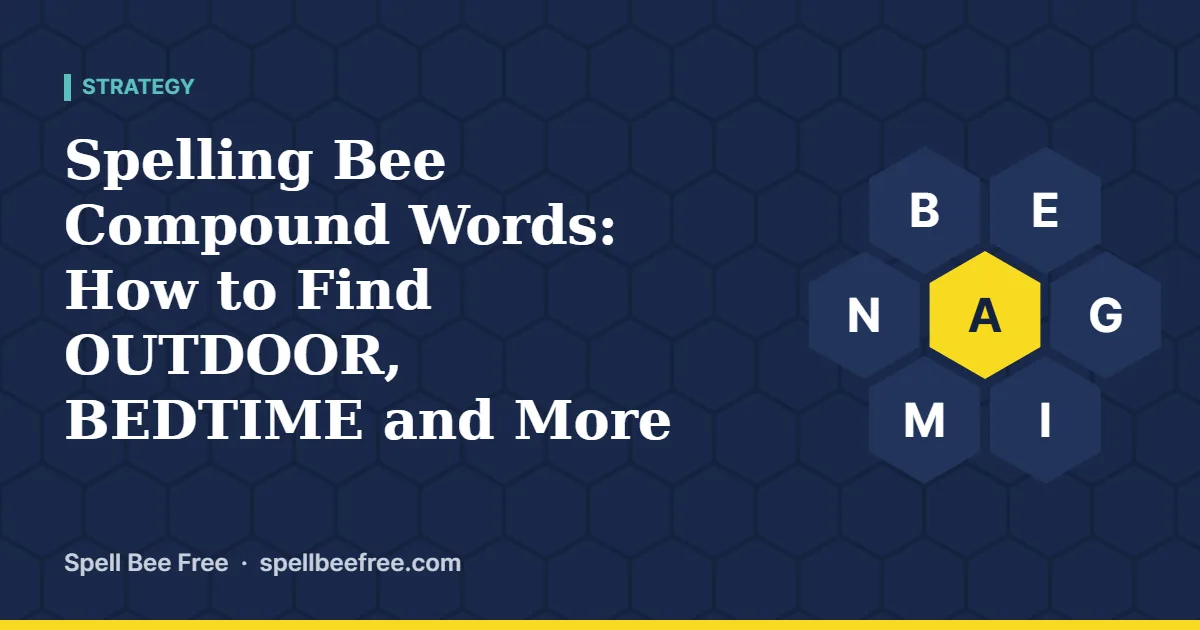
Spelling Bee Compound Words: How to Find OUTDOOR, BEDTIME and More
How to spot compound words in a Spelling Bee hive, the building blocks that show up most, why many compounds can never fit, and a worked example board.
Key takeaways
- A compound word is two words joined together, like OUT + DOOR. In Spelling Bee they are usually long, so they score well.
- Start from short building blocks the hive can spell: OUT, DOOR, BED, TIME, BOOK, WORK, ANY, UP.
- Many famous compounds can never appear: BUTTERFLY and KEYBOARD use eight different letters, and anything with S is out.
- On the D-E-O-P-R-T-U board with O in the center, OUTDOOR, DROPOUT, OUTPUT and UPROOT are all answers, and UPROOTED is a pangram.
- Once a block works, try it at both ends: OUT starts OUTDO and finishes DROPOUT.
A compound word is two smaller words glued together: OUT + DOOR = OUTDOOR, BED + TIME = BEDTIME. In Spelling Bee they are some of the best answers on the board, because they are long, they score one point per letter, and most players miss them. Here’s how to spot them, which ones are worth looking for, and why so many famous compounds can never appear.
The quick version
Find the short words first, then try gluing them together. Spelling Bee hives are full of three- and four-letter building blocks: OUT, UP, DOOR, BED, BOOK, TIME. Every pair you can join is a possible answer. Try both orders, because DROP + OUT and OUT + DO both work.
What counts as a compound word
In Spelling Bee a compound word has to be:
- Written as one word. OUTDOOR is fine. “Ice cream” and “well-known” are not, because the game takes only single words with no space or hyphen.
- Made of letters in the hive. Both halves must use only the seven letters on the board.
- Built around the center letter. The full word must contain the center letter. One half can skip it, as long as the other half uses it.
- Four letters or longer. Almost every compound is, so this rule rarely matters.
The center-letter rule is the one that trips people up. On a board with O in the middle, UPPER is no good, but UPROOT is, because ROOT carries the O.
A worked example board
Take the board D, E, P, R, T, U with O in the center. Our answer list has 131 words for that board. Here are the compound words hiding in it:
| Compound | Building blocks | Letters | Points |
|---|---|---|---|
| OUTDO | OUT + DO | 5 | 5 |
| OUTPUT | OUT + PUT | 6 | 6 |
| UPROOT | UP + ROOT | 6 | 6 |
| OUTDOOR | OUT + DOOR | 7 | 7 |
| DROPOUT | DROP + OUT | 7 | 7 |
| UPROOTED | UP + ROOTED | 8 | 15 (pangram) |
UPROOTED uses all seven letters, so it is a pangram and earns its length plus a 7-point bonus. The board has two other pangrams, PROTRUDE and PURPORTED, but the compound route is the easiest way in: once you see UP and ROOT, UPROOTED is one step away.
Notice how the same blocks keep returning. OUT appears in four of the six words. When one block works, try it with everything else you’ve found.
Building blocks worth knowing
These short words show up in a lot of compounds and fit a lot of boards. Every example below is on the Spell Bee Free answer list.
| Block | Example compounds |
|---|---|
| OUT | OUTDO, OUTPUT, OUTDOOR, OUTLINE, DROPOUT, WORKOUT, LOOKOUT, TAKEOUT, HANDOUT |
| DOOR | DOORBELL, DOORMAT, INDOOR, OUTDOOR |
| BED | BEDROOM, BEDTIME, HOTBED |
| TIME | BEDTIME, ANYTIME, LIFETIME, TIMELINE |
| BOOK | NOTEBOOK, COOKBOOK, BOOKWORM |
| WORK | HOMEWORK, FIREWORK, NETWORK, WOODWORK, WORKOUT |
| ANY | ANYONE, ANYBODY, ANYTIME, ANYWHERE |
| UP | UPROOT, UPON, UPTOWN |
| CAKE | CUPCAKE, PANCAKE |
A simple way to use this table: when you see the letters of a block in the hive, say the block out loud and run through the words that pair with it.
Why many compounds can never appear
Some of the most familiar compound words will never show up in Spelling Bee, for two reasons.
1. The seven-letter limit. A hive has seven letters, so a word can use at most seven different letters. Plenty of compounds use more:
- BUTTERFLY: B, U, T, E, R, F, L, Y (eight)
- KEYBOARD: K, E, Y, B, O, A, R, D (eight)
- PLAYGROUND, WHEELCHAIR, GRAPEFRUIT and JELLYFISH: all too many
Repeated letters don’t count twice, which is why long words like DOORBELL (D, O, R, B, E, L) still fit.
2. There is no S. The puzzle never uses the letter S, so SUNSET, SEAWEED, LIGHTHOUSE and BOOKCASE are all out. So is every plural, which is why you’ll never see OUTDOORS.
Knowing this saves time. If a compound feels long, count its different letters before you type it.
Five habits for finding compounds
- Collect short words early. Short words are the raw material. Words under four letters don’t score, but they help you think: OUT, PUT and UP are worth noticing even though you can’t enter them.
- Try both orders. OUT + DO gives OUTDO; DROP + OUT gives DROPOUT. Many blocks work at the front and the back.
- Reuse a block that worked. If OUT made one compound, run it against every other short word on the board.
- Add an ending afterwards. UPROOT becomes UPROOTED, OUTDO becomes OUTDONE when the letters allow. Our word endings cheat sheet shows which endings to check.
- Check the center letter last. If your compound skips the center letter, it won’t count, however good it looks.
Compounds also pair well with prefixes. Words like OVERBOARD and UNDERDOG sit between the two ideas, so the Spelling Bee prefixes guide is a natural next read.
Compounds and the pangram
Long compounds are strong pangram candidates because they use many different letters at once. When you’re stuck on the pangram, list the building blocks the hive can spell and try joining the longest two. That is how UPROOTED falls out of the example board. For a full method, see how to find the pangram fast.
How much can compounds add?
Most compound words are six to eight letters long, so each one is worth six to eight points, and a compound pangram is worth far more. On the example board, the six compounds above add up to 46 points. That kind of boost is often what pushes a game from Great or Amazing up to Genius. The ranks and points guide shows how much each rank needs.
Practice tip
Open unlimited mode and play a few boards where you write down every short word you see, even three-letter ones you can’t enter. Then spend two minutes only on joining them. When you finish, run the board through the Spelling Bee solver and look for compounds you missed. After a few games you’ll start seeing OUT, DOOR and TIME the moment the hive loads.
Quick recap
Compound words are long, high-scoring and easy to miss. Find the short building blocks first, join them in both orders, and reuse any block that works. Skip compounds with an S or more than seven different letters, because they can never fit. And when the pangram won’t come, try the longest compound you can build.
Frequently asked questions
Are compound words allowed in Spelling Bee?
Yes, as long as they are written as one word with no space or hyphen. OUTDOOR, BEDTIME and NOTEBOOK are fine. Two-word phrases and hyphenated words are not accepted.
Why can't I find BUTTERFLY or KEYBOARD in Spelling Bee?
A Spelling Bee hive has seven letters. BUTTERFLY uses eight different letters (B, U, T, E, R, F, L, Y) and so does KEYBOARD, so neither word can ever fit a board.
Which compound words come up most in Spelling Bee?
Compounds built from short, common blocks: words with OUT (OUTDO, OUTPUT, WORKOUT), DOOR (INDOOR, DOORBELL), BED (BEDROOM, BEDTIME), TIME (ANYTIME, LIFETIME) and BOOK (NOTEBOOK, COOKBOOK).
Can a compound word be the pangram?
Yes. On the D-E-O-P-R-T-U board, UPROOTED (UP + ROOTED) uses all seven letters, so it is a pangram worth its length plus a 7-point bonus.
What is the fastest way to find compound words in the hive?
Find two or three short words first, then try joining them in both orders. If you have OUT and DO, try OUTDO. If you have DROP and OUT, try DROPOUT.
Keep reading
Spelling Bee Double Letters: How to Find TOLL, BALLOON and More
Why you can use a letter twice in Spelling Bee, which double letters show up most, the doubling rule for -ED and -ING, and a worked example board.
Spelling Bee Prefixes: RE-, UN-, IN-, DE- and the Ones That Never Work
Which Spelling Bee prefixes add the most answers, which ones can never appear (hint: no S), and a 30-second check that turns one word into a whole family.
Spelling Bee Word Endings Cheat Sheet: -ING, -ED, -ER and More
The word endings that unlock the most Spelling Bee answers: -ING, -ED, -ER, -LY, -ION and more, with what to look for in the hive and examples for each.